
Average Household Electricity Usage: How Much Power Does a Typical Home Use?
Discover the average household electricity usage by home size, appliance type, and season. Learn how many kWh a typical home uses and how to reduce energy costs.
Calcifyai Team
Expert calculators & financial tools
Have you ever looked at your electricity bill and wondered whether your energy usage is normal?
Understanding the average household electricity usage can help you compare your home's energy consumption, identify opportunities to save money, and improve energy efficiency.
Whether you're trying to reduce your electricity bill, estimate solar panel requirements, or simply understand your energy habits, knowing how much electricity a typical home uses is an important first step.
You can also use a KWH Calculator to estimate appliance energy consumption and compare it against average household usage.
What Is Average Household Electricity Usage?
Average household electricity usage refers to the amount of electricity a typical home consumes over a specific period, usually measured in kilowatt-hours (kWh).
Electricity consumption varies depending on factors such as:
Home size
Number of occupants
Climate
Appliance usage
Heating and cooling systems
Energy efficiency
Because every household is different, there is no single number that applies to everyone.
How Is Electricity Usage Measured?
Utility companies measure electricity consumption using kilowatt-hours (kWh).
A kWh represents:
1,000 watts used for 1 hour
or
100 watts used for 10 hours
If you're unfamiliar with this unit, read our guide on What Is a kWh?
Understanding kWh makes it easier to analyze your electricity bill and compare household energy usage.
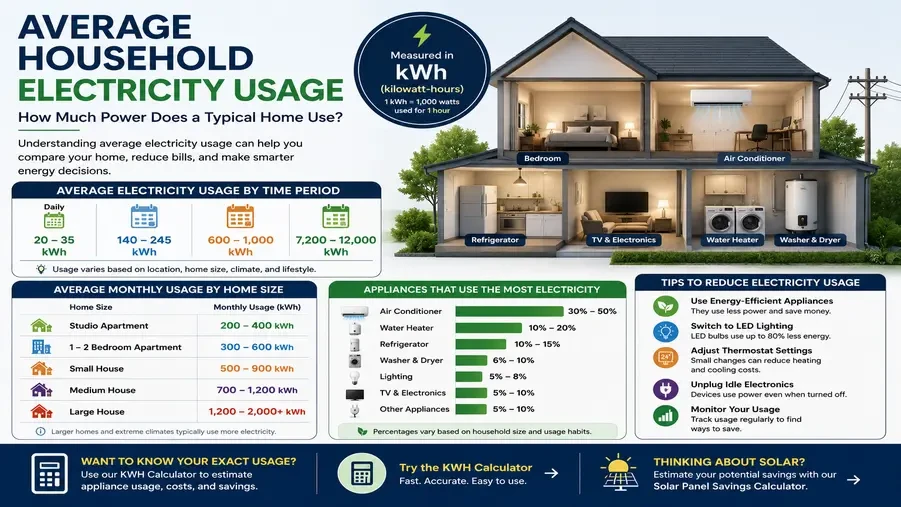
Average Electricity Usage Per Household
While actual consumption varies by country and household size, many homes use between:
Time Period | Average Usage |
Daily | 20–35 kWh |
Weekly | 140–245 kWh |
Monthly | 600–1,000 kWh |
Yearly | 7,200–12,000 kWh |
Homes in hotter climates often consume more electricity because of air conditioning usage.
Likewise, homes using electric heating systems may experience significantly higher winter energy consumption.
Electricity Usage by Home Size
Larger homes typically use more electricity because they contain more rooms, lighting, and appliances.
Home Size | Estimated Monthly Usage |
Studio Apartment | 200–400 kWh |
1–2 Bedroom Apartment | 300–600 kWh |
Small House | 500–900 kWh |
Medium House | 700–1,200 kWh |
Large House | 1,200–2,000+ kWh |
Actual consumption depends heavily on appliance usage and lifestyle habits.
Which Appliances Use the Most Electricity?
A few appliances are responsible for the majority of household energy consumption.
Air Conditioners
Cooling systems often account for the largest portion of summer electricity bills.
Learn more in How Much Electricity Does an AC Use?
Refrigerators
Refrigerators operate continuously and contribute significantly to annual electricity consumption.
Read our guide on How Much Electricity Does a Refrigerator Use?
Other High-Energy Appliances
Electric water heaters
Clothes dryers
Electric ovens
Dishwashers
Space heaters
Pool pumps
For detailed appliance power ratings, see our Appliance Energy Consumption Chart.
Factors That Affect Household Electricity Usage
Climate
Homes in hot climates typically use more electricity for cooling.
Homes in colder climates may consume more electricity if they rely on electric heating systems.
Number of Occupants
More people generally means:
More lighting
More appliance usage
More hot water consumption
More electronics
Appliance Efficiency
Modern energy-efficient appliances consume significantly less electricity than older models.
Learn more in our guide on Energy Efficiency Ratings Explained.
Lifestyle Habits
Energy usage varies depending on:
Time spent at home
Thermostat settings
Appliance usage patterns
Work-from-home arrangements
How to Calculate Your Household Electricity Usage
You can estimate energy consumption using the formula:
Electricity Consumption (kWh) = (Watts × Hours Used) ÷ 1000
For example:
A 1500W air conditioner running for 8 hours:
(1500 × 8) ÷ 1000 = 12 kWh
If you need help performing these calculations, read our guide on How to Calculate Electricity Consumption.
Use a KWH Calculator to Measure Home Energy Usage
Manually calculating household energy consumption can become difficult when multiple appliances are involved.
A KWH Calculator helps you estimate:
Daily electricity usage
Monthly energy consumption
Appliance operating costs
Annual power usage
Utility bill estimates
Instead of calculating each appliance individually, you can enter wattage and usage hours to receive instant results.
How Much Electricity Should Your Home Use?
There is no perfect number because every household is unique.
However, you should investigate your electricity usage if:
Bills increase unexpectedly
Consumption rises without explanation
Appliances are aging
Energy usage is significantly above average
Tracking your electricity consumption monthly can help identify unusual patterns early.
How to Reduce Household Electricity Usage
Reducing energy consumption can lower utility bills and improve efficiency.
Upgrade to Energy-Efficient Appliances
Newer appliances often use less electricity while delivering better performance.
Switch to LED Lighting
LED bulbs consume significantly less electricity than traditional incandescent bulbs.
Adjust Thermostat Settings
Small temperature changes can reduce heating and cooling costs substantially.
Unplug Idle Electronics
Many devices consume standby power even when turned off.
Monitor Appliance Usage
Understanding where energy is being used is the first step toward reducing consumption.
Read our guide on How to Reduce Your Electricity Bill for additional savings strategies.
Household Electricity Usage and Solar Panels
Knowing your monthly electricity consumption is essential before installing solar panels.
Solar installers typically use your annual kWh usage to determine:
Solar system size
Number of panels required
Potential savings
Return on investment
To estimate your solar savings, read our Solar Panel Savings Calculator Guide.
Frequently Asked Questions
How much electricity does the average household use?
Most homes consume between 600 and 1,000 kWh per month, although actual usage varies significantly.
What uses the most electricity in a home?
Typically:
Air conditioners
Electric water heaters
Clothes dryers
Heating systems
Refrigerators
How can I check my household electricity usage?
You can review your utility bill or use a KWH Calculator to estimate appliance energy consumption.
Is 1,000 kWh per month a lot?
It depends on home size, climate, and occupancy.
For many households, 1,000 kWh falls within a normal range.
How can I reduce electricity usage?
Improving appliance efficiency, adjusting thermostat settings, and monitoring energy consumption can significantly reduce electricity bills.
Final Thoughts
Average household electricity usage varies depending on home size, climate, appliance efficiency, and lifestyle habits. Understanding your energy consumption helps you compare usage against national averages, reduce utility bills, and make smarter energy decisions.
Whether you're evaluating appliances, reducing electricity costs, or planning a solar installation, monitoring household energy consumption is essential. Use our KWH Calculator to estimate electricity usage and gain better control over your home's energy consumption.
Disclaimer
The information provided in this article is for educational and informational purposes only. It should not be considered as professional financial, medical, or legal advice. Always consult with qualified professionals for specific guidance related to your situation.
Popular Calculators
Explore our most-used free calculators for finance, health, and everyday needs.