
How to Calculate the Area of Composite Shapes
Learn how to calculate the area of composite shapes with simple formulas, step-by-step examples, and practical tips for solving geometry problems.
Calcifyai Team
Expert calculators & financial tools
A composite shape is a figure made by combining two or more simple shapes, such as rectangles, triangles, squares, or circles. To calculate the area of composite shapes, divide the figure into smaller shapes, find the area of each part, and then add or subtract the areas as needed.
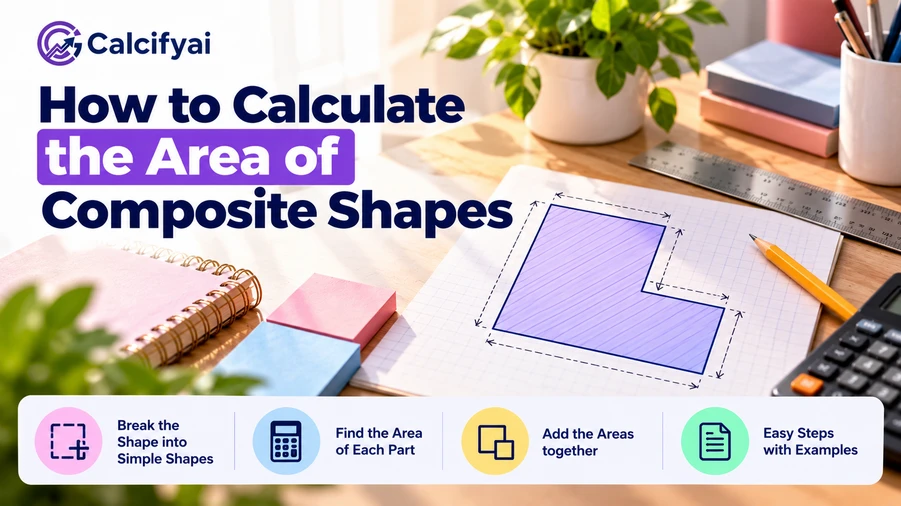
For example, an L-shaped figure can be divided into two rectangles. Calculate each rectangle's area and add the results to find the total area.
This method is useful for solving geometry problems, measuring rooms, planning gardens, estimating flooring materials, and working with other shapes that do not have one simple area formula.
What Is a Composite Shape?
A composite shape, also called a compound shape, is a two-dimensional figure made by joining two or more basic geometric shapes.
Common shapes used to create composite figures include:
Rectangles: Shapes with four right angles and opposite sides of equal length.
Squares: Shapes with four equal sides and four right angles.
Triangles: Shapes with three sides and three angles.
Circles and semicircles: Round shapes that may form part of a larger figure.
Trapezoids: Four-sided shapes with a pair of parallel sides.
A composite shape might look complicated at first, but breaking it into familiar parts makes the calculation easier.
Formula for the Area of Composite Shapes
There is no single formula for every composite shape. The method depends on which basic shapes form the figure.
The general rule is:
Total area = Area of Part 1 + Area of Part 2 + Area of Part 3 + ...
When a section is missing from a larger shape, use subtraction instead:
Total area = Area of the larger shape − Area of the missing section
Here are some common area formulas you may need:
Shape | Area Formula |
|---|---|
Rectangle | Length × Width |
Square | Side × Side |
Triangle | (Base × Height) ÷ 2 |
Circle | 3.14 × Radius × Radius |
Semicircle | (3.14 × Radius × Radius) ÷ 2 |
Trapezoid | ((Base 1 + Base 2) × Height) ÷ 2 |
You can use these formulas to calculate the area of each section before combining the results.
If you want to understand how these formulas work for different figures, explore this guide to finding the area of geometric shapes, which explains how to break down shapes and combine their areas.
How to Calculate the Area of Composite Shapes Step by Step
Follow these steps to find the area of most composite figures.
Examine the figure. Identify the simple shapes that make up the entire figure.
Divide the figure. Draw lines to separate it into rectangles, triangles, or other familiar shapes.
Find missing measurements. Use the given dimensions to calculate any lengths you need.
Calculate each area. Apply the correct formula to every section.
Add or subtract the areas. Combine the results to find the total area.
Check your answer. Make sure you have used consistent units and written the result in square units.
Let's apply this method to a few examples.
Examples of Finding the Area of Composite Shapes
Example 1: Find the Area of an L-Shaped Figure
Suppose an L-shaped figure can be divided into two rectangles:
Rectangle 1: 10 m long and 6 m wide
Rectangle 2: 4 m long and 3 m wide
Step 1: Calculate the area of Rectangle 1.
Area = 10 × 6 = 60 m²
Step 2: Calculate the area of Rectangle 2.
Area = 4 × 3 = 12 m²
Step 3: Add the two areas.
Total area = 60 + 12 = 72 m²
The area of the L-shaped figure is 72 square meters.
Example 2: Find the Area of a Rectangle With a Triangle on Top
Imagine a composite figure made from a rectangle and a triangle attached to its top.
The measurements are:
Rectangle length = 8 cm
Rectangle width = 5 cm
Triangle base = 8 cm
Triangle height = 4 cm
Step 1: Find the rectangle's area.
Area = 8 × 5 = 40 cm²
Step 2: Find the triangle's area.
Area = (8 × 4) ÷ 2 = 16 cm²
Step 3: Add the areas.
Total area = 40 + 16 = 56 cm²
The total area of the composite figure is 56 square centimeters.
Example 3: Find the Area by Subtracting a Missing Section
Sometimes it is easier to calculate the area of a large shape and subtract a smaller section that has been removed.
Suppose a large rectangle measures 12 m by 9 m. A smaller rectangle measuring 4 m by 3 m is removed from one corner.
Step 1: Calculate the area of the large rectangle.
Area = 12 × 9 = 108 m²
Step 2: Calculate the area of the missing rectangle.
Area = 4 × 3 = 12 m²
Step 3: Subtract the missing area.
Total area = 108 − 12 = 96 m²
The area of the remaining figure is 96 square meters.
Example 4: Find the Area of a Shape With a Semicircle
A composite shape can also contain curved sections. Consider a rectangle with a semicircle attached to one side.
Suppose:
Rectangle length = 10 cm
Rectangle width = 6 cm
Semicircle diameter = 6 cm
First, calculate the rectangle's area:
10 × 6 = 60 cm²
The semicircle has a radius of 3 cm because its diameter is 6 cm.
Calculate its area:
(3.14 × 3 × 3) ÷ 2 = 14.13 cm²
Now add the two areas:
60 + 14.13 = 74.13 cm²
The total area is approximately 74.13 square centimeters.
How to Find Missing Measurements
Some composite shape problems do not provide every measurement directly. You may need to calculate a missing length before finding the area.
For example, imagine a figure made from two rectangles placed side by side. The total length is 15 m, and one rectangle is 6 m long.
To find the other rectangle's length:
15 − 6 = 9 m
You can now use the missing measurement to calculate that rectangle's area.
For L-shaped figures, you may also need to subtract one known side length from another to find the width or height of a smaller section. Check the diagram carefully to see which measurements line up.
Common Mistakes When Calculating Composite Areas
Even simple calculations can go wrong if you divide the figure incorrectly or use the wrong measurements.
1. Using the Wrong Area Formula
Each basic shape has its own formula. A triangle's area is not calculated in the same way as a rectangle's area.
Tip: Identify every section before choosing a formula.
2. Forgetting to Subtract a Missing Section
If you use the area of a complete rectangle to calculate an L-shaped figure, remember to subtract the missing part.
Tip: Check whether your divided shapes cover the entire figure or extend beyond its boundary.
3. Counting the Same Section Twice
When dividing a composite figure, make sure the smaller shapes do not overlap.
Tip: Draw clear dividing lines and label each section.
4. Mixing Different Units
Measurements may be given in centimeters, meters, inches, or feet. Mixing units without converting them can lead to an incorrect answer.
Tip: Convert all measurements to the same unit before calculating.
5. Forgetting Square Units
Area measures the space inside a two-dimensional figure, so the answer must use square units.
For example, a result calculated using meters should be written in square meters (m²), not meters (m).
Real-Life Uses of Composite Shape Area
Calculating composite areas is useful in many everyday situations.
Home improvement: Calculate the floor area of an L-shaped room before buying flooring.
Gardening: Measure a garden made from rectangular and triangular sections.
Construction: Estimate the surface area of walls and other structures.
Interior design: Work out the area of unusual room layouts.
Landscaping: Calculate the area of a yard with different sections.
Crafts and design: Measure materials for projects made from several geometric shapes.
For more examples of dividing unusual figures into simpler parts, read our guide on calculating the area of irregular shapes.
Frequently Asked Questions
How do you calculate the area of a composite shape?
Divide the figure into smaller, familiar shapes. Calculate the area of each part using its formula, then add the areas together. If the figure contains a missing section, subtract that section's area instead.
What is the difference between a composite shape and an irregular shape?
A composite shape is made by combining two or more simple geometric shapes. An irregular shape does not follow the standard form of a familiar shape. Some irregular shapes can also be treated as composite shapes when they can be divided into simpler parts.
Can you calculate the area of a composite shape by subtraction?
Yes. If the figure fits inside a larger shape, calculate the larger shape's area and subtract the area of the section that is not included.
How do you find the area of an L-shaped figure?
You can divide an L-shaped figure into two rectangles and add their areas. Alternatively, calculate the area of the complete outer rectangle and subtract the missing rectangular section.
What units are used for composite shape area?
Area is measured in square units, such as square centimeters (cm²), square meters (m²), square inches (in²), and square feet (ft²).
Can a composite shape contain circles and triangles?
Yes. Composite shapes can combine many types of geometric figures, including circles, semicircles, triangles, rectangles, and trapezoids. Calculate each section separately and then combine the results.
Is there an online calculator for composite shapes?
You can use the Area Calculator to calculate the area of individual geometric shapes. For a composite figure, calculate each section separately and then add or subtract the results.
Conclusion
Calculating the area of composite shapes becomes easier when you break a complicated figure into smaller, familiar parts. Identify the shapes, find any missing measurements, calculate each area, and combine the results.
Remember the main rule: add the areas of sections that make up the figure, or subtract the area of any missing section. Keep your measurements consistent and use square units for the final answer.
With practice, you can use this method to solve geometry problems and measure real-world spaces with unusual shapes.
Disclaimer
The information provided in this article is for educational and informational purposes only. It should not be considered as professional financial, medical, or legal advice. Always consult with qualified professionals for specific guidance related to your situation.
Popular Calculators
Explore our most-used free calculators for finance, health, and everyday needs.