
Mixing Ratios for Cooking, Paint, and Construction (Complete Guide)
Learn how mixing ratios work in cooking, paint mixing, and construction projects. Discover common ratio formulas, examples, and tips to achieve accurate results every time.
Calcifyai Team
Expert calculators & financial tools
Ratios are used every day in practical situations, especially when mixing ingredients, materials, or liquids. Whether you're preparing a recipe, mixing paint colors, or creating concrete for a construction project, using the correct ratio is essential for achieving the desired result.
Even small mistakes in mixing ratios can affect taste, color, strength, durability, and overall quality.
In this guide, you'll learn how mixing ratios work, how to calculate them, and how they're used in cooking, painting, and construction projects.
If you're new to ratios, start with our guide on How to Calculate Ratios Step by Step to understand the fundamentals before working with mixing ratios.
What Is a Mixing Ratio?
A mixing ratio is the relationship between two or more ingredients or materials being combined. Understanding the ratio formula makes it easier to calculate ingredient quantities accurately in real-world mixing applications.
It tells you how much of one component should be mixed with another.
Example
A paint mixture requires:
2 parts paint
1 part thinner
Ratio:
2:1
This means for every 2 units of paint, you need 1 unit of thinner.
Why Mixing Ratios Matter
Using the correct ratio ensures:
Consistent results
Proper texture
Correct color
Material strength
Product quality
Reduced waste
Incorrect ratios often lead to failed projects and unnecessary expenses.
Mixing Ratios in Cooking
Cooking is one of the most common applications of ratios.
Recipes depend on maintaining the correct balance between ingredients.
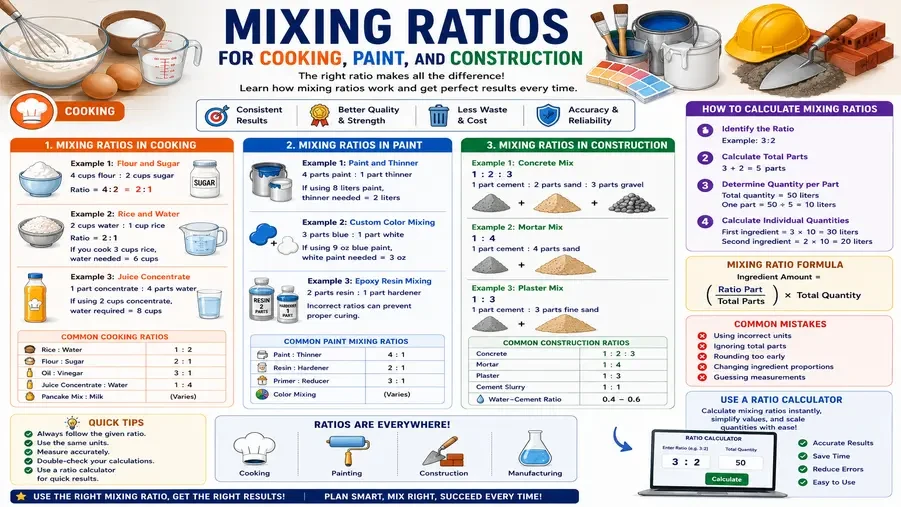
Example 1: Flour and Sugar Ratio
Recipe:
4 cups flour
2 cups sugar
Ratio:
4:2
Simplified:
2:1
This means you need twice as much flour as sugar.
Example 2: Rice and Water Ratio
Many rice recipes use:
2:1
Ratio:
2 cups water
1 cup rice
If you cook 3 cups of rice:
Water needed:
3 × 2
= 6 cups
Example 3: Juice Concentrate
Instructions:
1 part concentrate : 4 parts water
If using 2 cups concentrate:
Water required:
2 × 4
= 8 cups
Final mixture:
10 cups
Common Cooking Ratios
Food Item | Mixing Ratio |
Rice : Water | 1:2 |
Flour : Sugar | 2:1 |
Oil : Vinegar | 3:1 |
Juice Concentrate : Water | 1:4 |
Pancake Mix : Milk | Varies by recipe |
Mixing Ratios in Paint
Painters rely heavily on ratios to achieve specific colors, textures, and finishes.
Example 1: Paint and Thinner
Ratio:
4:1
4 parts paint
1 part thinner
If using:
8 liters paint
Required thinner:
2 liters
Example 2: Custom Color Mixing
To create a specific shade:
3 parts blue
1 part white
Ratio:
3:1
If using:
9 ounces blue paint
White paint needed:
3 ounces
Example 3: Epoxy Resin Mixing
Many epoxy products use:
2:1
Ratio:
2 parts resin
1 part hardener
Incorrect ratios can prevent proper curing.
Common Paint Mixing Ratios
Application | Typical Ratio |
Paint : Thinner | 4:1 |
Resin : Hardener | 2:1 |
Primer : Reducer | 3:1 |
Color Mixing | Varies |
Mixing Ratios in Construction
Construction projects often require precise material ratios.
Incorrect ratios can weaken structures and increase costs. Construction professionals frequently use a ratio calculator to verify material proportions before mixing concrete, mortar, or plaster.
Example 1: Concrete Mix Ratio
A common concrete mix:
1:2:3
Meaning:
1 part cement
2 parts sand
3 parts gravel
Example 2: Mortar Mix Ratio
Standard mortar:
1:4
Meaning:
1 part cement
4 parts sand
Example 3: Plaster Mix
Ratio:
1:3
Meaning:
1 part cement
3 parts fine sand
Example 4: Water-Cement Ratio
Construction engineers frequently use:
0.4 to 0.6
Water-Cement Ratio
This ratio significantly affects concrete strength.
Common Construction Mixing Ratios
Material | Typical Ratio |
Concrete | 1:2:3 |
Mortar | 1:4 |
Plaster | 1:3 |
Cement Slurry | 1:1 |
Water-Cement | 0.4–0.6 |
How to Calculate Mixing Ratios
Step 1: Identify the Ratio
Example:
3:2
Step 2: Calculate Total Parts
3 + 2
= 5 parts
Step 3: Determine Quantity per Part
Suppose total mixture:
50 liters
One part:
50 ÷ 5
= 10 liters
Step 4: Calculate Individual Quantities
First ingredient:
3 × 10
= 30 liters
Second ingredient:
2 × 10
= 20 liters
Mixing Ratio Formula
The formula is:
Ingredient Amount = (Ratio Part ÷ Total Parts) × Total Quantity
This formula works for cooking, paint mixing, construction, and manufacturing.
Common Mixing Ratio Mistakes
Using Incorrect Units
Always use the same measurement unit.
Ignoring Total Parts
Calculate total ratio parts before dividing.
Rounding Too Early
Keep calculations precise.
Changing Ingredient Proportions
Maintain the exact ratio to preserve quality.
Guessing Measurements
Use measuring tools whenever possible. These issues are discussed in more detail in our article on Common Ratio Mistakes and How to Avoid Them.
Benefits of Using Correct Mixing Ratios
Better consistency
Reduced material waste
Improved product quality
Stronger construction materials
Accurate recipe outcomes
Professional results
Frequently Asked Questions
What is a mixing ratio?
A mixing ratio shows how much of each ingredient or material should be combined.
Why are mixing ratios important?
They ensure consistency, quality, and predictable results.
What is the most common concrete mixing ratio?
A common concrete mix ratio is 1:2:3.
How do I calculate mixing quantities?
Use the ratio formula and divide the total quantity by total parts.
Can I calculate mixing ratios automatically?
Yes. You can use a ratio calculator to calculate mixing ratios instantly and avoid manual mistakes.
Conclusion
Mixing ratios are essential in cooking, paint preparation, and construction projects. Whether you're following a recipe, creating custom paint colors, or mixing concrete, maintaining the correct ratio ensures consistent and reliable results.
Understanding how to calculate and apply ratios can save time, reduce waste, and improve quality across countless real-world applications.
For fast and accurate calculations, try our ratio calculator to determine mixing ratios, simplify values, and scale quantities instantly.
Disclaimer
The information provided in this article is for educational and informational purposes only. It should not be considered as professional financial, medical, or legal advice. Always consult with qualified professionals for specific guidance related to your situation.
Popular Calculators
Explore our most-used free calculators for finance, health, and everyday needs.