
VA Loan vs Conventional Loan: Which Mortgage Option Is Better?
VA loan vs conventional loan: discover differences in mortgage insurance, rates, eligibility, and monthly payments before choosing the right home loan.
Calcifyai Team
Expert calculators & financial tools
Choosing the right mortgage is one of the most important financial decisions you'll make when purchasing a home. For veterans, active-duty service members, and eligible military families, the choice often comes down to a VA loan versus a conventional mortgage.
While both loan types can help finance a home purchase, they differ significantly in terms of down payment requirements, mortgage insurance, interest rates, qualification standards, and long-term affordability.
Understanding these differences can help you identify the financing option that best aligns with your homeownership goals and financial situation.
Understanding VA Home Loans
Before comparing loan options, it's important to understand how government-backed military mortgages work. These loans are supported by the Department of Veterans Affairs and offer unique advantages that aren't typically available through traditional financing programs.
If you're new to the program, you may want to review our guide to military-backed home financing to learn how VA loans help eligible borrowers achieve homeownership with fewer upfront costs.
Conventional Mortgages Explained
Unlike VA loans, conventional mortgages are not guaranteed by a government agency. Because lenders assume more risk, they often require larger down payments, stronger credit profiles, and additional forms of borrower protection such as private mortgage insurance.
Conventional financing remains a popular option for borrowers who do not qualify for military lending programs or who are purchasing investment properties and second homes.
Down Payment Comparison
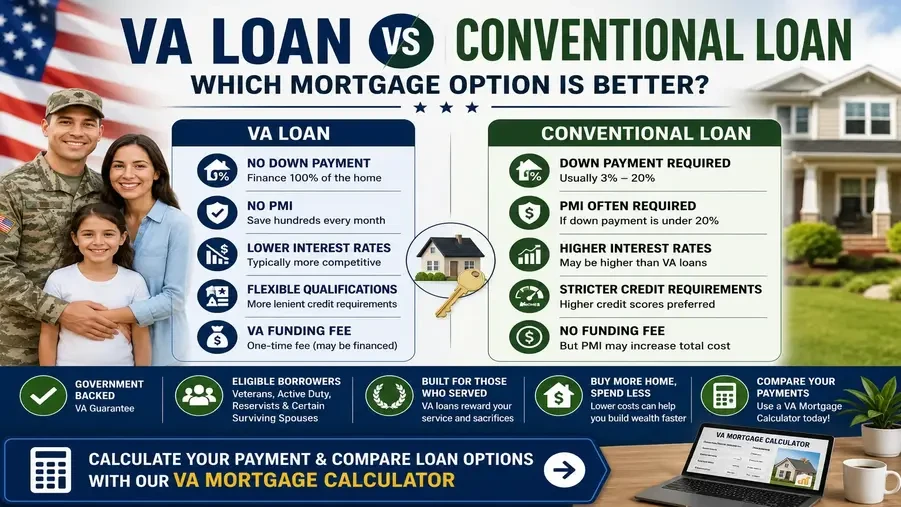
One of the biggest distinctions between these mortgage options is the amount of money required upfront.
VA Loan
Many eligible borrowers can purchase a home with no down payment, allowing them to preserve savings for moving expenses, emergency funds, or home improvements.
Conventional Loan
Most conventional mortgages require a down payment ranging from 3% to 20%, depending on the lender and loan program.
For homebuyers looking to minimize upfront expenses, VA financing often provides a significant advantage.
Mortgage Insurance Costs
Monthly mortgage insurance can substantially increase housing costs over time.
VA Loan
VA borrowers typically avoid private mortgage insurance entirely, even when financing 100% of the home's purchase price.
Conventional Loan
Borrowers who put less than 20% down are often required to pay PMI until they build sufficient equity.
Over several years, those monthly insurance premiums can add up to thousands of dollars.
Interest Rate Differences
Mortgage interest rates directly affect monthly payments and total borrowing costs.
Because lenders receive additional protection through the VA guarantee, military borrowers frequently qualify for competitive rates compared to conventional financing.
If you're evaluating various purchase prices and rate scenarios, consider using a VA Mortgage Calculator to see how even small interest rate differences can impact long-term costs.
Qualification Requirements
VA Financing
Eligibility is based primarily on military service history and entitlement status.
Borrowers must meet service-related requirements established by the Department of Veterans Affairs.
If you're unsure whether you qualify, our military mortgage qualification guide explains service requirements, Certificates of Eligibility, and lender expectations in greater detail.
Conventional Financing
Approval depends entirely on financial factors such as:
Income
Credit score
Assets
Debt obligations
Employment history
Funding Fees vs PMI
Many borrowers compare the VA funding fee to PMI, but these costs work very differently.
VA loans generally include a one-time funding charge that supports the loan program and helps maintain benefits for future veterans.
By contrast, conventional loans often require ongoing monthly insurance payments.
To better understand these costs, review our explanation of the one-time fee associated with VA-backed mortgages, including exemption rules and financing options.
Monthly Payment Comparison
Let's consider a simplified example using a $400,000 home purchase.
VA Loan Scenario
No down payment
No PMI
Competitive interest rate
Conventional Loan Scenario
5% Down payment
Monthly PMI
Potentially higher interest rate
In many cases, the VA loan produces a lower monthly payment despite financing a larger portion of the home's purchase price.
A mortgage payment planning tool designed for veterans can help compare different financing structures and determine which option best fits your budget.
When a VA Loan May Be the Better Choice
VA financing is often advantageous when:
You qualify through military service
You want to avoid PMI
You prefer lower upfront costs
You want maximum purchasing flexibility
You have limited cash reserves
When a Conventional Loan May Be More Appropriate
A conventional mortgage may be worth considering if:
You don't qualify for VA benefits
You're buying an investment property
You're purchasing a vacation home
You can comfortably make a substantial down payment
Final Thoughts
For many eligible veterans and military families, VA loans offer significant financial advantages through lower upfront costs, flexible qualification standards, and the absence of private mortgage insurance.
However, every homebuyer's situation is unique.
Before making a final decision, estimate your monthly housing expenses using a home financing calculator built for military borrowers. Comparing multiple loan scenarios can help you determine the most affordable path to homeownership.
You may also benefit from exploring our overview of veteran home loan programs, understanding military borrowing eligibility requirements, and reviewing the upfront costs associated with VA financing before submitting a mortgage application.
Disclaimer
The information provided in this article is for educational and informational purposes only. It should not be considered as professional financial, medical, or legal advice. Always consult with qualified professionals for specific guidance related to your situation.
Popular Calculators
Explore our most-used free calculators for finance, health, and everyday needs.