
First-Time Buyer Mortgage Guide UK: Everything You Need to Know
Learn everything first-time buyers need to know about UK mortgages, deposits, affordability, government schemes, and mortgage approval tips.
Calcifyai Team
Expert calculators & financial tools
Buying your first home is an exciting milestone, but it can also feel overwhelming. Between saving a deposit, understanding mortgage options, and navigating the buying process, first-time buyers often have many questions.
Fortunately, understanding how mortgages work can make the journey much smoother.
Whether you're planning to buy your first flat, house, or new-build property, this guide covers everything you need to know about getting a mortgage in the UK.
Before viewing properties, many buyers use a first home mortgage calculator to estimate monthly repayments and determine a realistic budget.
Who Qualifies as a First-Time Buyer?
In the UK, you're generally considered a first-time buyer if:
You've never owned a residential property before.
You don't own property anywhere in the world.
You're purchasing your main residence.
First-time buyer status may qualify you for certain government incentives and Stamp Duty relief.
How Does a First-Time Buyer Mortgage Work?
A first-time buyer mortgage works similarly to any other residential mortgage.
You contribute a deposit and borrow the remaining amount from a lender.
Example
Property Price: £280,000
Deposit: £28,000 (10%)
Mortgage Required: £252,000
The lender provides the mortgage, which you repay over an agreed term with interest.
A house buying calculator UK can help estimate your monthly payments before applying.
How Much Deposit Do First-Time Buyers Need?
Most lenders require at least a 5% deposit.
Typical Deposit Levels
Deposit | Loan-to-Value |
5% | 95% |
10% | 90% |
15% | 85% |
20% | 80% |
While a 5% deposit may be enough, larger deposits often unlock lower interest rates.
For a detailed breakdown, see our guide on Mortgage Deposit Explained.
How Much Can a First-Time Buyer Borrow?
Most lenders offer between 4 and 4.5 times annual income.
Example
Annual Income | Estimated Borrowing |
£30,000 | £120,000–£135,000 |
£40,000 | £160,000–£180,000 |
£50,000 | £200,000–£225,000 |
£60,000 | £240,000–£270,000 |
Actual borrowing amounts depend on:
Income
Expenses
Credit history
Deposit size
Existing debts
Many buyers use a mortgage qualification calculator to estimate borrowing capacity before applying.
Government Schemes for First-Time Buyers
Lifetime ISA (LISA)
The government adds a 25% bonus to eligible savings.
Shared Ownership
Buy a share of a property and pay rent on the remainder.
First Homes Scheme
Provides eligible buyers with discounts on selected properties.
Government schemes can make homeownership more accessible for first-time buyers struggling to save large deposits.
Fixed vs Variable Mortgage: Which Is Better?
First-time buyers often choose fixed-rate mortgages because repayments remain predictable.
Fixed Rate Benefits
Stable monthly payments
Easier budgeting
Protection against rising rates
Variable Rate Benefits
Potentially lower rates
More flexibility
Benefit if rates fall
You can learn more in our guide comparing Fixed vs Variable Rate Mortgages.
What Credit Score Do You Need?
There is no universal minimum credit score.
However, lenders typically prefer applicants with:
Consistent payment history
Low credit utilisation
Stable finances
No recent defaults
Improving your credit profile before applying may help secure better mortgage deals.
Additional Costs First-Time Buyers Often Forget
Many buyers focus only on the deposit.
However, you should also budget for:
Solicitor Fees
Legal costs involved in transferring ownership.
Survey Fees
Property inspections and valuations.
Moving Costs
Removal services and transportation.
Mortgage Arrangement Fees
Some lenders charge product fees.
Insurance
Buildings insurance is usually required.
Using a home buying costs calculator alongside mortgage planning tools can help avoid budgeting surprises.
Common First-Time Buyer Mistakes
Buying at the Top of Your Budget
Leave room for future expenses and unexpected costs.
Ignoring Mortgage Affordability
Lenders look beyond income alone.
Not Comparing Mortgage Products
Different lenders may offer significantly different rates and fees.
Skipping Mortgage Calculations
Understanding your repayments before applying can prevent future financial stress.
A mortgage cost estimator can help evaluate affordability before making an offer.
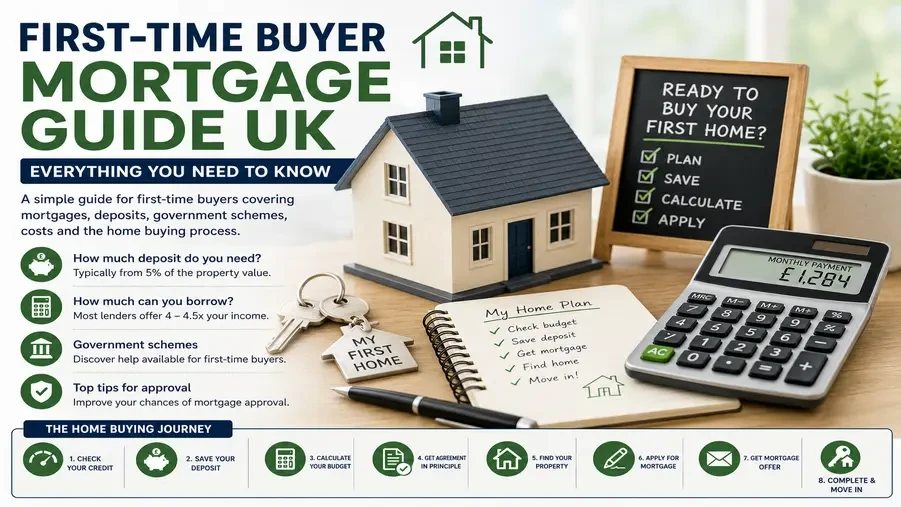
Step-by-Step Mortgage Application Process
Step 1: Check Your Credit Report
Review your credit history for errors.
Step 2: Save Your Deposit
Aim for the largest deposit possible.
Step 3: Calculate Your Budget
Estimate repayments and affordability.
Step 4: Get a Mortgage Agreement in Principle
Shows sellers you're a serious buyer.
Step 5: Find a Property
Begin your property search.
Step 6: Submit Your Mortgage Application
Provide income and financial documentation.
Step 7: Receive Mortgage Offer
Your lender issues a formal mortgage offer.
Step 8: Complete the Purchase
Exchange contracts and receive the keys.
Frequently Asked Questions
Can first-time buyers get a mortgage with 5% deposit?
Yes. Many lenders offer mortgages with just a 5% deposit.
Is it better to save a larger deposit?
Usually yes. Larger deposits often result in better interest rates and lower monthly repayments.
Do first-time buyers pay Stamp Duty?
Some first-time buyers may qualify for Stamp Duty relief depending on property value and eligibility.
How long does mortgage approval take?
Most applications take between two and six weeks, although timing varies by lender.
Should I use a mortgage calculator before applying?
Yes. Mortgage calculators help estimate affordability, repayments, and borrowing capacity.
Final Thoughts
Buying your first home can seem complicated, but understanding the mortgage process makes it far more manageable.
From saving a deposit and improving your credit score to comparing mortgage products and budgeting for additional costs, preparation is key.
Before starting your property search, use our mortgage planning tools to estimate repayments, assess affordability, and create a realistic home-buying budget. The better prepared you are, the smoother your journey to homeownership will be.
Disclaimer
The information provided in this article is for educational and informational purposes only. It should not be considered as professional financial, medical, or legal advice. Always consult with qualified professionals for specific guidance related to your situation.
Popular Calculators
Explore our most-used free calculators for finance, health, and everyday needs.