
Financial Ratios Every Investor Should Know (Complete Guide)
Learn the most important financial ratios investors use to evaluate stocks, companies, and investments. Understand profitability, liquidity, valuation, and efficiency ratios with examples.
Calcifyai Team
Expert calculators & financial tools
Successful investors don't rely solely on stock prices or market trends when making investment decisions. Instead, they use financial ratios to evaluate a company's performance, profitability, efficiency, and overall financial health.
Financial ratios transform complex financial statements into simple comparisons that help investors identify strong businesses and avoid risky investments.
In this guide, you'll learn the most important financial ratios every investor should understand and how to use them effectively.
You can also use our ratio calculator to calculate ratios instantly.
What Are Financial Ratios?
Financial ratios are mathematical comparisons between numbers found in a company's financial statements.
They help investors evaluate:
Profitability
Liquidity
Debt levels
Operational efficiency
Company valuation
Financial stability
Instead of reviewing hundreds of financial statement figures, investors can focus on a few key ratios.
Why Financial Ratios Matter
Financial ratios help investors:
Compare companies
Identify trends
Evaluate risk
Find undervalued stocks
Measure profitability
Analyze financial strength
Investors often use an online ratio calculator to speed up financial analysis and compare companies efficiently.
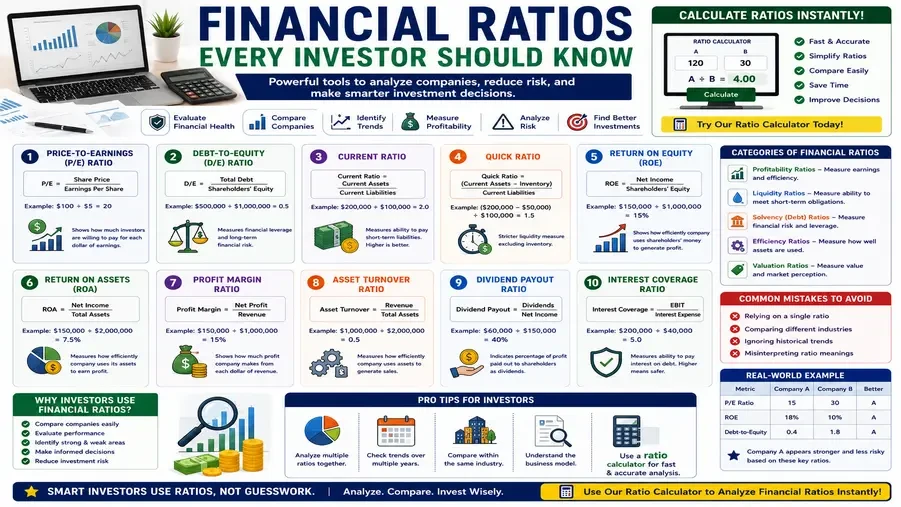
1. Price-to-Earnings (P/E) Ratio
The P/E ratio measures how much investors are willing to pay for each dollar of earnings.
Formula
P/E Ratio = Share Price ÷ Earnings Per Share
Example
Share Price:
$100
EPS:
$5
P/E Ratio:
20
This means investors are paying $20 for every $1 of earnings.
Why Investors Use P/E Ratios
Compare stock valuations
Identify expensive stocks
Find potentially undervalued opportunities
2. Debt-to-Equity Ratio (D/E)
The Debt-to-Equity Ratio measures a company's financial leverage.
Formula
Debt-to-Equity Ratio = Total Debt ÷ Shareholders' Equity
Example
Debt:
$500,000
Equity:
$1,000,000
Ratio:
0.5
A lower ratio generally indicates lower financial risk.
3. Current Ratio
The Current Ratio measures a company's ability to pay short-term obligations.
Formula
Current Ratio = Current Assets ÷ Current Liabilities
Example
Assets:
$200,000
Liabilities:
$100,000
Current Ratio:
2.0
This means the company has twice as many current assets as liabilities.
4. Quick Ratio
The Quick Ratio provides a stricter liquidity measurement.
Formula
Quick Ratio = (Current Assets − Inventory) ÷ Current Liabilities
A higher quick ratio usually indicates stronger short-term financial health.
5. Return on Equity (ROE)
ROE measures how effectively management uses shareholder capital.
Formula
ROE = Net Income ÷ Shareholders' Equity
Example
Net Income:
$150,000
Equity:
$1,000,000
ROE:
15%
Higher ROE often indicates better management performance.
6. Return on Assets (ROA)
ROA evaluates how efficiently a company uses its assets.
Formula
ROA = Net Income ÷ Total Assets
Investors often compare ROA across companies in the same industry.
7. Profit Margin Ratio
Profit Margin measures how much profit a company generates from revenue.
Formula
Profit Margin = Net Profit ÷ Revenue
Example
Revenue:
$1,000,000
Profit:
$150,000
Profit Margin:
15%
8. Asset Turnover Ratio
This ratio measures operational efficiency.
Formula
Asset Turnover = Revenue ÷ Total Assets
Higher ratios indicate better asset utilization.
9. Dividend Payout Ratio
The Dividend Payout Ratio shows how much profit is distributed to shareholders.
Formula
Dividend Payout Ratio = Dividends ÷ Net Income
Income investors often monitor this ratio closely.
10. Interest Coverage Ratio
This ratio measures a company's ability to meet interest payments.
Formula
Interest Coverage = EBIT ÷ Interest Expense
Higher ratios generally indicate lower financial risk.
Comparing Financial Ratios
No single ratio tells the entire story.
Investors should evaluate:
Profitability ratios
Liquidity ratios
Debt ratios
Efficiency ratios
Valuation ratios
Using a financial ratio calculator helps investors compare multiple metrics quickly.
Common Mistakes Investors Make
Relying on One Ratio
Always analyze multiple financial ratios.
Comparing Different Industries
Ratios vary significantly across industries.
Ignoring Historical Trends
Review financial ratios over multiple years.
Misinterpreting Ratios
Many mistakes occur because investors misunderstand ratio relationships.
Learn more in Common Ratio Mistakes and How to Avoid Them.
Real-World Example
Suppose two companies have:
Metric | Company A | Company B |
P/E Ratio | 15 | 30 |
ROE | 18% | 10% |
Debt-to-Equity | 0.4 | 1.8 |
Based on these ratios, Company A may appear financially stronger and less risky.
A ratio analysis tool can help investors compare companies side-by-side.
Frequently Asked Questions
What is the most important financial ratio?
There is no single best ratio. Most investors analyze several ratios together.
What ratio indicates financial health?
Current Ratio, Debt-to-Equity Ratio, and ROE are commonly used indicators.
Can financial ratios predict stock performance?
Not directly, but they help identify financially strong companies.
How do investors calculate ratios quickly?
Many investors use a ratio calculator for investors to calculate financial metrics instantly.
Conclusion
Financial ratios are among the most powerful tools available to investors. They simplify financial statements, improve decision-making, and help identify quality investment opportunities.
Whether you're evaluating stocks, mutual funds, or private businesses, understanding financial ratios can significantly improve your investment analysis.
To compare numbers efficiently and perform quick calculations, try our ratio calculator.
You may also find these resources helpful:
Disclaimer
The information provided in this article is for educational and informational purposes only. It should not be considered as professional financial, medical, or legal advice. Always consult with qualified professionals for specific guidance related to your situation.
Popular Calculators
Explore our most-used free calculators for finance, health, and everyday needs.